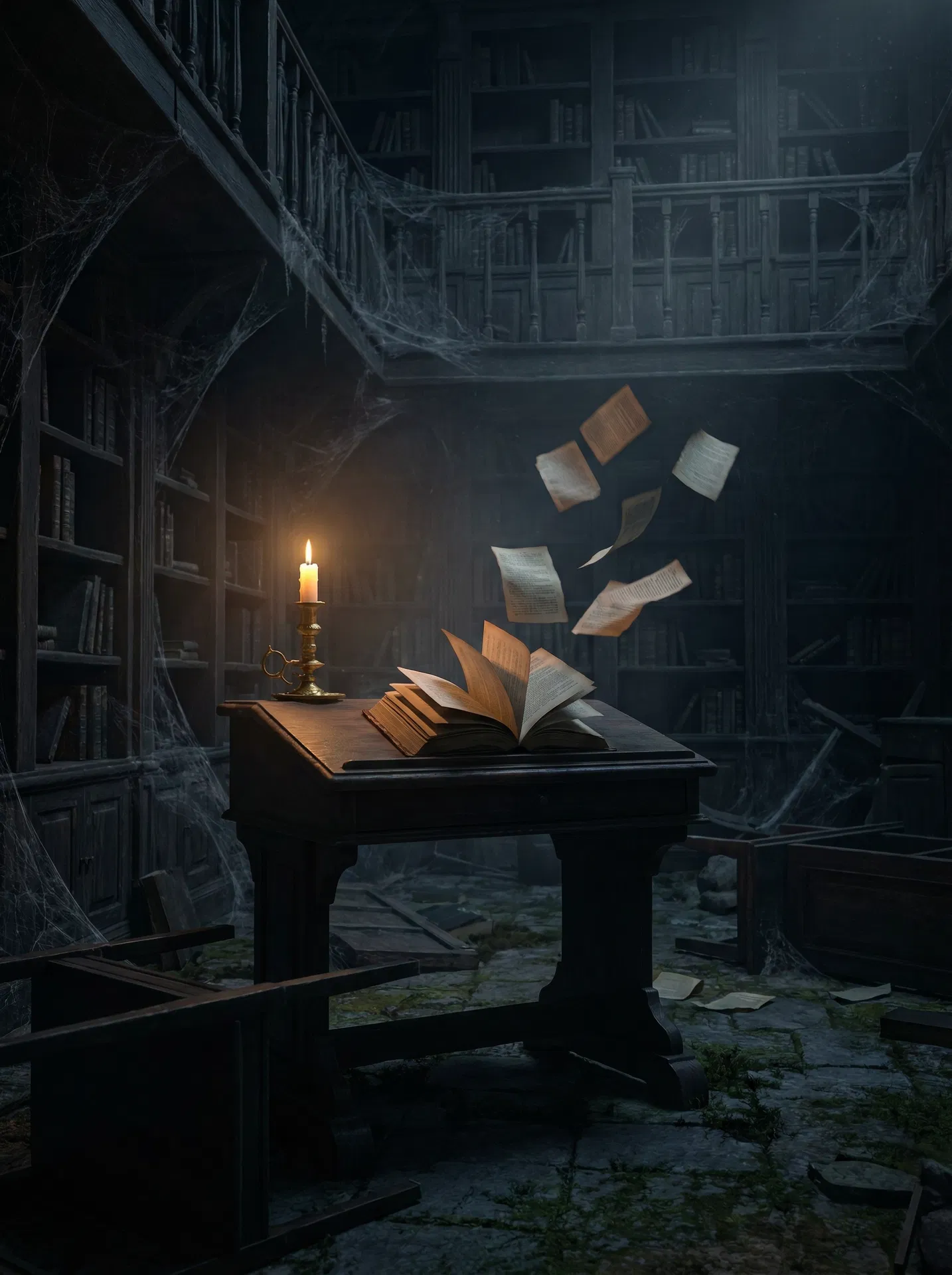
The library had been closed for thirty years, but every night at midnight, a light appeared in the third-floor window. No one in town talked about it. No one in town dared.
Evelyn Price was not from town. She was a graduate student in library science who had driven four hundred miles to see the Hollow Hill Collection — a legendary archive of manuscripts that scholars had been trying to access since the building was shuttered in 1996. The official reason for the closure was structural damage. The unofficial reason changed depending on who you asked and how much they'd had to drink.
She arrived at dusk. The building was exactly as the photographs had shown: a Victorian Gothic structure with pointed arches and gargoyles that looked less like decorations and more like warnings. The front door was chained, but the basement window was broken — had been broken, she suspected, for a very long time.
Inside, the air was thick with the smell of old paper and something else — something sweet and faintly chemical, like formaldehyde mixed with vanilla. Her flashlight cut through the darkness and found exactly what she'd hoped for: shelves. Thousands of them, stretching into the shadows like the ribs of some enormous sleeping creature.
She climbed to the second floor, then the third. The books here were different — older, bound in leather that had darkened with age to the color of dried blood. She ran her fingers along the spines and read titles she didn't recognize in languages she couldn't identify.
Then she heard it. A sound so quiet it was almost a feeling: the turning of a page.
She followed the sound to the end of the corridor, where a door stood slightly ajar. Warm light spilled through the gap — the same light, she realized, that the townspeople saw from outside.
She pushed the door open.
The room was a perfect circle, lined floor to ceiling with books. In the center sat a desk, and at the desk sat a woman. She was old — impossibly old — with white hair that pooled on the floor around her chair like spilled milk. She was reading a book so large it took up the entire desk, and she was turning its pages with fingers that were too long, too thin, too many.
"You're here for the collection," the woman said without looking up. Her voice sounded like pages rustling.
"Yes," Evelyn managed.
"Everyone who comes here is looking for something. The question is whether you're willing to leave something behind."
"What do you mean?"
The woman finally looked up. Her eyes were the color of old ink — not brown, not black, but the deep blue-black of words that have been written and rewritten until they've worn through the page.
"Every book in this library was written by someone who came looking for knowledge. They found it. But knowledge has a price, and the price is always the same: a story. Your story. The one you haven't written yet."
She gestured to an empty shelf behind her. "There's space for one more."
Evelyn looked at the shelf, then at the book on the desk. She could see now that it wasn't printed — it was handwritten, in thousands of different hands, each entry beginning with the same words: "I came to the library looking for..."
The woman held out a pen. It was old and beautiful and it gleamed in the lamplight like a living thing.
"You can leave now," the woman said. "The door will let you. But you'll spend the rest of your life wondering what you would have written."
Evelyn looked at the pen. She looked at the door. She thought about the four-hundred-mile drive, the years of research, the burning need to know that had brought her here.
She sat down.
The woman smiled — or at least, her mouth moved in a way that suggested she remembered what smiling was.
"Begin with your name," she said. "The library likes to know who it's keeping."
Evelyn picked up the pen. It was warm in her hand, almost alive.
She wrote her name, and somewhere in the building, a door closed.
Cynthia Zamora
Contributing Writer at Inkwell